Best Under-Cabinet Stemware Racks: Three Fits
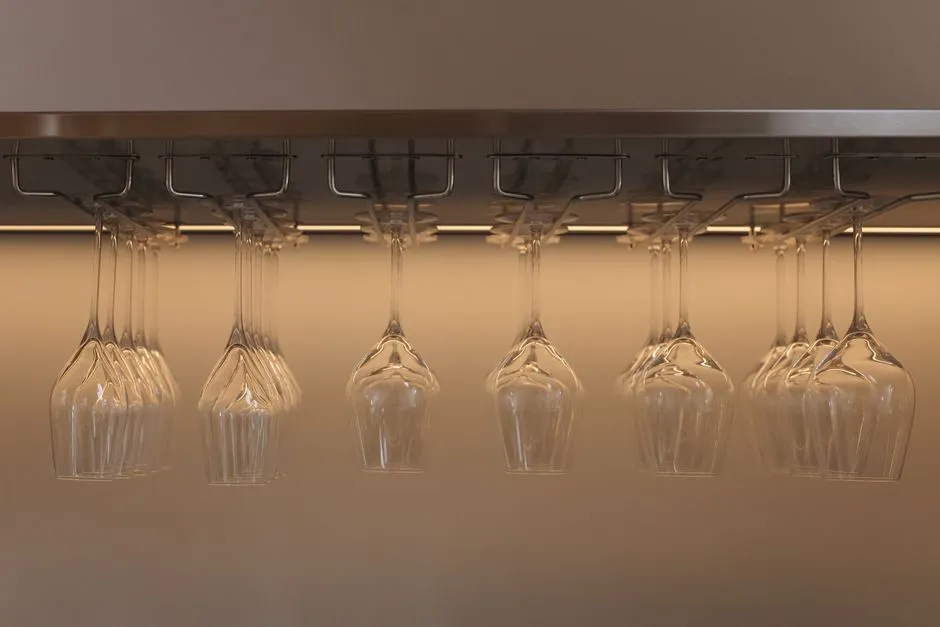
- Verdict: PÅLYCKE for removable, Rev-A-Shelf for permanent
- Top picks compared
- Why IKEA PÅLYCKE is the best removable rack
- Why Rev-A-Shelf 3150-16 is the best modular permanent row
- Why Rev-A-Shelf 3450-11 is the best multi-row unit
- How to measure a glass for any rack
- Installation checklist
- Where not to hang stemware
- Final choice
Verdict: PÅLYCKE for removable, Rev-A-Shelf for permanent
The IKEA PÅLYCKE is our best removable under-shelf rack for renters and cautious first installations. It clips to shelves 16–20 millimetres thick without drilling and is designed for at least three compatible glasses. Its fit window is narrow, so measure the shelf before celebrating the lack of screws.
Choose the Rev-A-Shelf 3150-16 single-row rack when you own the cabinet, want a permanent modular system, and have up to about five compatible glasses per row. Choose the Rev-A-Shelf 3450-11 quad holder when a roughly 17-by-11-inch under-cabinet area is available and you want one installation for up to about 12 standard glasses.
We have not physically tested these racks. Our picks are based on current published dimensions, installation, and stated capacities. Capacity always depends on your glass base and bowl. Stemware has never agreed to standardise itself for the convenience of storage writers.
Top picks compared
| Pick | Mount | Published size or fit | Stated capacity | Honest drawback |
|---|---|---|---|---|
| IKEA PÅLYCKE 905.344.37 | clip-on | 13 in deep; shelves 16–20 mm thick | at least 3 glasses | only fits a narrow shelf-thickness range |
| Rev-A-Shelf 3150-16 | four-screw single row | 4.25 W × 16 D × 1.5 H in | up to 5, shape dependent | permanent mounting; one row uses deep cabinet space |
| Rev-A-Shelf 3450-11 | four-screw quad | 17 W × 11 D × 1.5 H in | up to 12 standard glasses | wide footprint; bases around 4.5 in do not fit |
Verify the exact finish and model. Rev-A-Shelf sells multiple lengths and finishes under related series numbers. A 16-inch single row and an 11-inch quad are not variations you can swap after the holes are drilled.
Why IKEA PÅLYCKE is the best removable rack
The PÅLYCKE product page describes a powder-coated steel rack that clips beneath a shelf without drilling. It is 13 inches deep, fits shelves ⅝–¾ inch thick (16–20 millimetres), and provides space for at least three wine glasses. The bendable clips include EVA protectors.
Why it earns the pick
Installation is reversible. That matters in rented homes, in cabinets with uncertain construction, and for buyers who have not yet proved that hanging stemware suits their daily reach. The rack can move or return to paper-towel duty if the glasses refuse to cooperate.
The published shelf range makes the decision testable. Measure the shelf with callipers or a reliable ruler in several places, including any front lip. Confirm 13 inches of depth plus insertion room. Hang one inexpensive glass first and open and close every nearby door.
Honest drawback
It fits only a specific shelf thickness. Too thin and the clip may not seat as intended; too thick and it will not install. Do not force or bend it beyond the manufacturer's directions. The rack protrudes deeply, and at least three glasses is not a promise for wide bowls.
A clip-on device can be dislodged by cabinet contents, a door, or an upward bump. It also adds leverage to the shelf edge. Do not use it on damaged, glass, flexible, sloped, or otherwise incompatible shelving unless the manufacturer explicitly approves that material.
Who should skip it
Skip it when valuable or heavy stemware needs permanent security, when the shelf does not measure 16–20 millimetres, when a door front blocks the clip, or when the 13-inch projection creates head or counter conflict. Use upright padded shelf storage if no safe hanger fits.
Why Rev-A-Shelf 3150-16 is the best modular permanent row
The 3150-16 single-row under-cabinet holder is listed by established retailers at 4.25 inches wide, 16 inches deep, and 1.5 inches high. It holds up to about five glasses depending on their shape and size. The rack uses four screws and has a roughly 3.5-inch opening in current product information.
Why it earns the pick
A single row lets you start with one glass type and add another rack only if real capacity demands it. It uses less width than a quad unit and comes in multiple finishes. The 16-inch depth supports several bases in line where the cabinet or shelf is deep enough.
The permanent mount avoids a shelf-edge clip and can attach to an appropriate wood cabinet underside. This suits homeowners creating a dedicated bar zone beneath a cabinet or shelf.
Honest drawback
The 16-inch projection is substantial. It may extend beyond a shallow cabinet or hang glasses into a preparation area. “Up to five” can become three when bowls are broad. The 3.5-inch opening will not accept larger bases, and stem thickness also matters.
Four screws make the installation permanent. Screw length, cabinet panel thickness, edge distance, and substrate must all work together. Hardware can pierce a thin shelf or pull out of particleboard when poorly chosen. We cannot certify your cabinet from here; use the product manual and a qualified installer when uncertain.
Who should skip it
Skip it in rentals without permission, beneath glass or very thin panels, above a sink or hob, or where anyone's head crosses the hanging space. Skip it for oversized bases or antique glass whose maker recommends upright padded storage.
Why Rev-A-Shelf 3450-11 is the best multi-row unit
The 3450-11 quad rack is currently listed at 17 inches wide, 11 inches deep, and 1.5 inches high. It mounts with four screws and is described as holding up to 12 standard wine, champagne, martini, or similar glasses—about three per row, depending on shape.
Why it earns the pick
Four parallel rows create a coherent stemware zone with one mounting plate. At 11 inches deep, it is shallower than the 16-inch single row and can suit standard wall-cabinet depth. The product is offered in finishes including satin nickel and oil-rubbed bronze.
It is the clearest capacity pick for a matched set of medium-size glasses. Measure one representative glass, then multiply bowl diameter across each row and between rows. Capacity is geometry, not optimism.
Honest drawback
The unit consumes about 17 inches of width. Retailer Q&A indicates a 4.5-inch base will not fit and suggests about 3.5 inches as the maximum opening. Large Burgundy, balloon, coupe, or decorative bases can sharply reduce or eliminate capacity.
The rack still depends on four fasteners and a suitable cabinet underside. A wide loaded unit concentrates several fragile objects overhead. It is not the place for unverified adhesive strips, random screws, or a panel that sounds hollow because it is.
Who should skip it
Skip it for mixed oversized stemware, narrow cabinets, low counters, or areas where people lean or work below. A series of single racks may adapt better to varied glasses; an upright shelf may be safer.
How to measure a glass for any rack
Measure the widest diameter of the base, the stem thickness near the base, the widest bowl diameter, and total height. Add a small handling allowance. The base must pass through the opening and rest on the rails; the stem must slide without binding; bowls in adjacent positions must not touch.
Measure the heaviest glass too. Do not use stated glass count as a load limit. Use the manufacturer's weight limit when published; if none is available, ask the maker rather than inventing one.
Cut a cardboard rectangle matching the rack footprint and tape it under the proposed cabinet. Hang paper templates at the glass height. Open doors and appliances, stand at the counter, and simulate inserting a glass from the real direction. This catches the cupboard handle that looked innocent on the floor plan.
Installation checklist
Identify the cabinet material and thickness. Check for electrical wiring, lights, pipes, hinges, and hidden hardware. Compare screw length with the panel so tips cannot enter the storage cavity. Respect edge distances and use every required fixing point.
For clip-on racks, clean and inspect the shelf, fit the protector, seat the clip fully, and stay within the stated shelf range. For screw-mounted racks, use the template or actual mounting plate, drill pilot holes only where the instructions specify, and avoid overtightening.
Load one low-value glass and leave the area clear while observing. Add glasses gradually. Recheck fasteners and movement. Never exceed a load or hang mugs, bottles, or tools unless the rack approves them.
If a cabinet is not suitable, do not “upgrade” the adhesive. Choose an upright padded shelf, enclosed glass cabinet, or structurally supported wall system. Gravity has no loyalty to the aesthetic concept.
Where not to hang stemware
Avoid hobs, ovens, sinks, doorways, high-traffic passages, children's reach, and direct sun. Heat and grease dirty glasses; sink splashes and overhead handling invite slips. Hanging racks should not obstruct work lights, ventilation, smoke detectors, sprinklers, or appliance doors.
Keep alcohol in separate secured storage when household access demands it. A beautiful glass display does not require an open bottle display. Our bar cart versus cabinet guide makes that risk decision first.
For a small mobile setup, see the measured bar-cart picks, but remove hanging or loose stemware before rolling. For bottle orientation and light, use the liquor storage guide.
Final choice
Renters with the correct shelf thickness should start with PÅLYCKE and test real glass clearance. Homeowners wanting adaptable rows should use the 3150-16 only with suitable structure. Matched medium stemware and adequate width make the 3450-11 the capacity pick.
Buy after measuring the glasses, not before. The rack is the inexpensive part of a falling-stemware incident, and even the cheapest flute deserves better than being used as a structural test instrument.